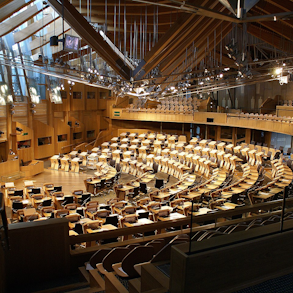
On Thursday 7 May, Scotland is to elect a new parliament. As a consequence of dwindling support for the traditional two-party system and vote splitting on both the left and right, the SNP are set to once again become the largest party and are likely to gain an outright majority. While the SNP itself is expected to receive a reduced vote share compared to 2021, their electoral success is cemented by the lack of a credible or unified opposition.
For the first time since the creation of the Scottish Parliament in 1999, neither the Conservatives nor Labour are expected to form the government or the official opposition. Current polling indicates that Reform UK are on course to become the second largest party in Holyrood, representing a significant political milestone and potential electoral legitimization.
The Scottish Parliament uses an Additional Member System to elect 129 MSPs. Seventy-three seats are elected under "first past the post" in single-member constituencies, with the remainder elected across eight larger regions, with seven seats each. These final 56 seats are elected using proportional representation and a modified D'Hondt formula.
The 73 Single Member Constituencies which are elected via FPTP are the primary catalyst for the SNP's anticipated success in this election. Despite current constituency vote polling placing the party 10pc down on their 2021 performance, their saving grace has come from a growth and diversification of perceived legible parties by the electorate.
Norstat's most recent poll for The Sunday Times (27-30 April 2026) has the Conservatives, Labour, Reform, Greens and the Liberal Democrats all between 10pc-20pc of the regional vote. The nearest challenger being Reform, who are operating on a rolling average of 19pc, based on the five most recent polls (as of 4 May). This splitting of the vote and the withdrawal of the Green Party from all but six Single Member Constituencies, allows the SNP to be rewarded by FPTP's inherent disposition to producing majority governments on a plurality vote.The inclusion of tactical voting is also likely to exacerbate the deepest political cleavage in Scotland, the question of independence. Due to the nature of the Additional Member System, the SNP are unlikely to receive many seats from the proportional segment of the election. Those who are pro-independence compound their influence by voting for the SNP at the constituency level and the Greens at the regional. A combined SNP-Green total exceeding 75 seats would represent a structurally amplified pro-independence majority, but it would be largely constructed by constituency dominance and opposition fragmentation.
| Party | Predicted Seats | Seat Range |
|---|---|---|
| SNP | 65 | 55-69 |
| Reform | 21 | 16-30 |
| Labour | 13 | 10-24 |
| Green | 12 | 10-24 |
| Conservative | 11 | 8-22 |
| Liberal Democrats | 7 | 4-18 |
| Total | 129 |
At the actual election, the SNP hold control of Holyrood as predicted. The seats won by each party were: SNP 58 seats, Reform 17, Labour 17, Green 15, Conservative 12, and Lib Dem 10. Every party's seat total was within our predicted range.
As we predicted, the SNP was the largest party, and able to continue in government, though they fell short of an overall majority. We predicted a range of 55-69 seats, and the SNP won 58 seats. We also predicted Reform would be the second largest party, and they were in joint second place with Labour on 17 seats each.
You can read our original (and time-stamped) prediction Tweet.